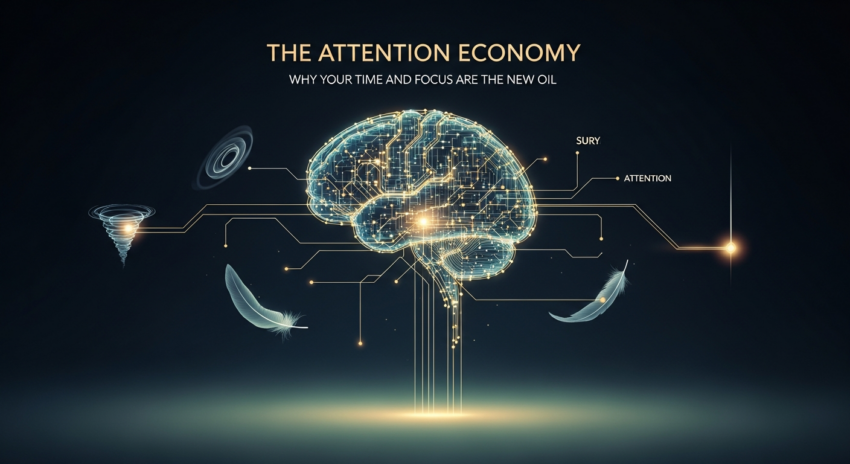


The Attention Economy: Why Your Time and Focus Are the New Oil
Every single day, countless digital platforms, social applications, and advertisers compete fiercely for a single, finite resource. This highly coveted asset is not real estate, precious metals, or fiat currency. It is your daily focus. Welcome to the attention economy, a highly sophisticated digital ecosystem where human engagement is systematically extracted, packaged, and sold to the highest corporate bidder. Just as fossil fuels powered the industrial revolution, human cognitive bandwidth now serves as the primary fuel driving modern digital commerce. This article will thoroughly dissect how this invisible market operates and provide you with actionable solutions to reclaim your time, protect your focus, and safeguard your overall financial well-being.
In this hyper-connected digital landscape, every single click, swipe, and prolonged viewing session generates measurable revenue for technology conglomerates. You might operate under the assumption that you are utilizing free software services, but in reality, you are paying a premium price with your most irreplaceable asset. By comprehending the underlying mechanics of this value exchange, you gain the power to make highly informed decisions. You can transition from a passive consumer into an active guardian of your personal resources.
Understanding the Mechanics of Cognitive Extraction
To successfully navigate modern digital environments, you must first understand exactly how technology platforms monetize human behavior. The foundational business model is remarkably straightforward yet devastatingly effective: the longer a platform can sustain your active engagement, the higher the volume of advertisements they can display, and the more granular behavioral data they can successfully harvest. This harvested data is subsequently utilized to engineer hyper-targeted marketing campaigns. In simple terms, your prolonged digital engagement translates directly into measurable corporate profit.
Software engineers and product designers deliberately build algorithms to exploit fundamental human psychology. They implement mechanisms such as intermittent variable rewards, a psychological concept identical to the mechanics of casino slot machines, to keep users scrolling perpetually. This relentless stream of push notifications and highly personalized content generates a continuous loop of dopamine-driven feedback in the human brain. Recognizing these precise psychological triggers serves as your crucial first step toward regaining absolute control over your daily schedule.
If you wish to fully grasp the broader systemic impacts of massive data commodification, evaluate our extensive resources detailing the macroeconomic trends that continuously shape today market structures. The global transition from manufacturing tangible goods to harvesting intangible behavioral data represents a monumental pivot in global commercial infrastructure.
The Hidden Financial Toll of Constant Distraction
The negative impact of continuous cognitive extraction extends far beyond simple daily procrastination. It carries profound and quantifiable financial implications. When your focus remains perpetually fractured, your professional productivity inevitably plummets. Experiencing chronic reduced productivity directly hinders your career advancement opportunities, severely limits your earning potential, and significantly decreases the overall quality of your intellectual output.
Furthermore, the attention economy relies heavily on manufacturing impulsive behavior. Social media feeds are meticulously curated to encourage spontaneous, unplanned purchases. Highly targeted advertisements seamlessly blend with organic user content, creating an environment where distinguishing between genuine personal needs and artificially manufactured desires becomes incredibly difficult. This predatory environment consistently leads to unnecessary discretionary spending, which relentlessly drains your capital over time.
Protecting your accumulated wealth requires immense psychological discipline. If you continuously yield to engineered digital temptations, reaching your primary financial milestones becomes an exceptionally difficult endeavor. For practical and effective methodologies to build and preserve your financial reserves, explore our comprehensive guides focused on personal savings optimization.

Actionable Strategies to Reclaim Your Mental Bandwidth
Possessing mere awareness of these systems is entirely insufficient to combat highly sophisticated algorithmic programming. You must actively implement rigorous structural changes to your daily lifestyle habits to defend your cognitive resources. By systematically treating your daily focus as a strictly finite investment, you can redirect your mental energy toward productive activities that yield substantial personal growth and measurable financial dividends.
Implement the following defensive strategies to fortify your cognitive boundaries immediately:
- Audit your digital consumption: Continuously track the exact number of hours you spend navigating various applications. Identify precisely which platforms consume the highest volume of your time without delivering any tangible return on investment.
- Restrict non-essential notifications: Actively prevent software applications from spontaneously interrupting your professional workflow. Configure your mobile devices to allow alert notifications exclusively from vital communication channels.
- Establish physical screen-free zones: Strictly designate specific physical locations in your home, such as the bedroom or the family dining table, where digital devices are categorically prohibited.
- Execute time-blocking techniques: Proactively allocate highly specific calendar periods for deep, uninterrupted professional work. Simultaneously, schedule short, strictly defined time windows exclusively for checking emails or casual web browsing.
These highly practical steps function as a robust protective barrier, preventing external algorithms from dictating your personal schedule. When you consciously dictate where your time goes, you instantly transform from an exploited data point into the active director of your own life.
Managing Your Time as an Investment Portfolio
In the complex realm of personal finance, asset diversification and strategic capital allocation stand as fundamental wealth-building principles. You must apply these exact same analytical principles to your daily focus. Time, unlike fiat currency or stocks, absolutely cannot be earned back or replenished once spent. It represents the ultimate depreciating asset. Therefore, the specific areas where you deliberately choose to direct your mental energy ultimately determine your future intellectual capacity and financial prosperity.
Instead of passively surrendering countless hours to consuming ephemeral, low-value content, invest that exact same time into acquiring high-income professional skills, expanding your foundational financial literacy, or actively developing secondary income streams. Evaluate the opportunity cost of your habits. Even systematically reallocating just one single hour a day from aimless digital scrolling toward focused market study will compound massively over an extended timeframe.
As you optimize your cognitive assets, you will naturally begin seeking superior avenues to multiply your capital. For instance, dedicating uninterrupted time to rigorous market research often leads directly to discovering highly advantageous investment opportunities that align perfectly with your long-term wealth objectives. Your disciplined focus always serves as the mandatory precursor to your ultimate financial success.
Navigating Distractions with Professional Guidance
Occasionally, overcoming deeply ingrained digital consumption habits and rectifying the complex financial mistakes caused by prolonged impulse buying requires objective, specialized intervention. If you determine that your long-term financial planning has been severely compromised by targeted digital consumerism, actively seeking external professional advice proves highly beneficial.
Always prioritize working exclusively with certified professionals who possess demonstrable experience in comprehensive wealth management and applied behavioral finance. A seasoned financial advisor will help you construct a highly robust, customized financial plan that actively accounts for modern digital temptations and aggressive marketing tactics. Avoid the counterproductive trap of constantly requesting multiple quotes from endless service providers, as this exact behavior often leads directly to analytical paralysis. Instead, focus entirely on identifying one single, highly qualified professional whose strategic methodology aligns flawlessly with your specific economic objectives.
Conclusion
The pervasive attention economy operates as an inescapable, structural reality of modern digital life. Massive technology entities will relentlessly continue to refine their advanced methodologies for capturing and monetizing your limited cognitive bandwidth. However, you maintain the absolute power to voluntarily opt out of this detrimental cycle of passive consumption. By firmly recognizing that your daily time and undivided focus are indeed the new oil, you can proactively guard these precious commodities against unwarranted corporate extraction.
Enforce strict digital boundaries, regularly audit your daily screen time, and consciously invest your mental energy exclusively into disciplined endeavors that foster genuine intellectual and financial growth. When you rigorously protect your focus, you simultaneously protect your financial future. Take authoritative charge of your daily digital habits starting today, and guarantee that your most valuable resources consistently work for your own personal benefit, rather than padding the profit margins of global digital conglomerates.
Frequently Asked Questions
What exactly defines the attention economy?
It constitutes a modern macroeconomic model where human engagement, daily focus, and screen time are officially treated as highly valuable, tradeable commodities. Digital platforms systematically capture user interest and aggressively monetize it by selling targeted advertising space and comprehensive behavioral data sets to third-party corporations.
How does excessive digital screen time directly impact personal finances?
Prolonged screen time continuously exposes you to an unrelenting stream of hyper-targeted advertisements and heavily curated lifestyle content, which dramatically increases the statistical likelihood of impulsive discretionary spending. Furthermore, chronically distracted working habits severely lower overall professional productivity, which frequently stalls career progression and actively restricts future earning capabilities.
What constitutes the most effective methodology to protect cognitive resources?
The most highly effective defensive approach requires treating your daily focus exactly like a strict financial budget. Regularly audit your digital consumption habits, ruthlessly eliminate unnecessary application notifications, and consistently utilize strict time-blocking strategies to dedicate completely uninterrupted periods to high-value professional tasks. Consciously assigning a specific, measurable purpose to your screen time successfully prevents algorithms from hijacking your daily routine.
About the Author: Money Minds, specialists in economics, finance, and investment.
View profile on LinkedIn
Related Posts