

Microeconomics vs. Macroeconomics: What’s the Difference and How Do They Both Affect You?
Understanding the difference between microeconomics and macroeconomics might sound like a dry academic exercise, but it is one of the most practical tools you can have for managing your personal finances. These two branches of economics are not just for experts; they are powerful lenses through which you can view your financial world. One looks at the details of your financial life, while the other examines the landscape in which you live it. This article will break down these two essential concepts, explain their key differences, and show you exactly how they impact your wallet, your investments, and your future.
By grasping the fundamentals of both micro and macroeconomics, you can make smarter decisions about everything from your daily budget to your long-term retirement plan. Let’s explore the small picture and the big picture to build a complete view of your financial well-being.
What is Microeconomics? A Look at the Small Picture
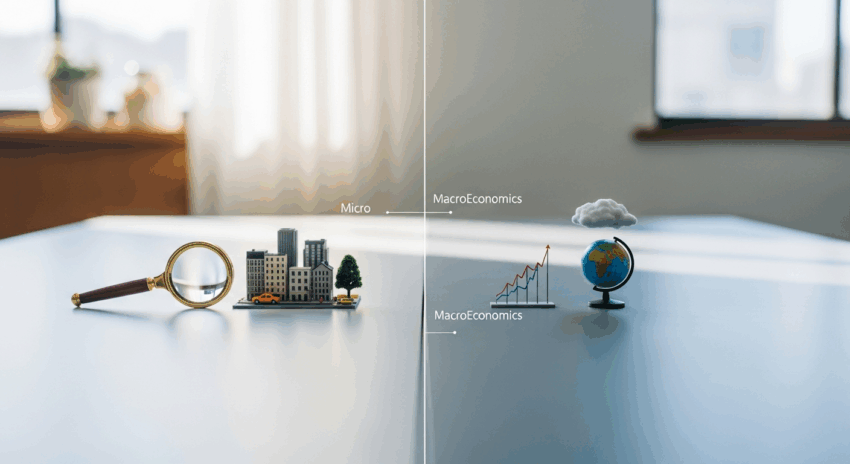
Microeconomics is the study of economic behavior at a small, individual level. Think of it as putting the economy under a microscope. It focuses on the decisions made by individual people, households, and businesses. It seeks to answer questions like: Why do you choose to buy one brand of coffee over another? How does a local restaurant decide its menu prices? What makes you ask for a raise at work?
The core of microeconomics revolves around the principles of supply and demand. This fundamental concept explains how prices are determined in a market. When many people want a product (high demand) and there is not much of it available (low supply), the price tends to go up. Conversely, if supply is high and demand is low, the price will likely fall. Microeconomics also examines production costs, market competition, and consumer behavior, providing a framework for understanding the choices that shape our immediate economic environment.
How Microeconomics Directly Influences Your Daily Life
You engage with microeconomic principles every single day, often without realizing it. Every purchase you make, every bill you pay, and every career move you consider is a microeconomic decision.
- Budgeting and Spending: When you create a budget, you are managing your personal demand for goods and services based on your limited supply of income. Deciding whether to spend money on a vacation, a new gadget, or to put it into your savings account is a classic microeconomic choice based on opportunity cost—the value of the next-best alternative you give up.
- Career and Income: The salary you earn is determined by the supply and demand for your skills in the job market. If you have a rare, in-demand skill, your potential income is higher. Understanding these dynamics can help you make strategic decisions about education, training, and career advancement.
- Investment Choices: On an individual level, microeconomics helps you analyze a specific company’s health before you invest. You look at its pricing power, production costs, market share, and competition—all microeconomic factors that influence its stock price.

What is Macroeconomics? Understanding the Big Picture
If microeconomics uses a microscope, macroeconomics uses a telescope. It looks at the economy as a whole, focusing on large-scale phenomena that affect entire countries and even the global population. Macroeconomics deals with the broad aggregates and averages of the economy, such as total national income, overall price levels, and the total number of jobs.
Key concepts in macroeconomics include Gross Domestic Product (GDP), which measures a country’s total economic output; inflation, the rate at which the general level of prices for goods and services is rising; unemployment rates; and interest rates set by central banks. Governments and major institutions use macroeconomic data to craft fiscal and monetary policy, aiming to foster stable growth, control inflation, and maintain low unemployment. These are the headline numbers you hear about in the news.
The Pervasive Impact of Macroeconomics on Your Finances
While macroeconomic forces may seem distant, their effects ripple down to impact your personal financial situation in profound ways. You cannot control these forces, but understanding them allows you to prepare and adapt your financial strategy.
- Interest Rates and Your Loans: When a central bank, like the Federal Reserve in the U.S., raises or lowers interest rates, it directly affects the cost of borrowing. A lower interest rate can make your mortgage, car loan, or credit card debt cheaper. Conversely, higher rates mean it costs more to borrow, but you will also earn more on your savings accounts and other fixed-income products.
- Inflation and Your Purchasing Power: Inflation erodes the value of your money. If the inflation rate is 3%, your money can buy 3% less than it could the year before. This is why simply saving cash is often not enough for long-term goals like retirement. To grow your wealth, your returns on investment must outpace the rate of inflation.
- Economic Growth and Job Security: The overall health of the economy, measured by GDP, directly impacts the job market. During periods of strong economic growth, companies expand, creating more jobs and often leading to higher wages. In a recession (a period of negative GDP growth), job security becomes a major concern as companies may resort to layoffs.
Micro and Macro: Two Interconnected Perspectives
It is crucial to understand that microeconomics and macroeconomics are not separate fields; they are deeply intertwined. The macro economy is, in essence, the sum of all the microeconomic decisions being made by individuals and firms. For example, widespread consumer confidence (a macro indicator) is built from millions of individual households feeling secure enough in their jobs and finances (micro) to spend money.
Similarly, a macroeconomic policy, such as a government tax cut, is designed to have a microeconomic effect: to leave more money in your pocket so you are encouraged to spend or invest, thereby stimulating the broader economy. A change in interest rates (macro) directly influences your decision-making on whether to take out a loan for a new car (micro). To truly master your personal finance, you must pay attention to both.
Conclusion: Using Both Lenses for a Clearer Financial Future
Distinguishing between microeconomics and macroeconomics is more than an academic exercise—it is a practical framework for financial literacy. Microeconomics empowers you to make optimal day-to-day decisions with your resources, from managing your budget to negotiating your salary. Macroeconomics provides the context for these decisions, helping you understand the broader economic tides that can either lift your boat or pose significant challenges.
By paying attention to both the small details and the big picture, you gain a comprehensive understanding of the forces shaping your financial life. This dual perspective allows you to navigate economic uncertainty with more confidence, protect your assets, and seize opportunities for growth. True financial empowerment comes from knowing not only how to manage your own money but also how your money fits into the world around you.
Frequently Asked Questions (FAQ)
Can I focus on just one, micro or macro, for my personal finances?
It is best to pay attention to both. While microeconomics helps with immediate, personal decisions like budgeting and saving, macroeconomics explains the environment in which those decisions are made. For example, understanding macro trends like inflation and interest rates is essential for making smart long-term investment and borrowing choices. They work together to give you a complete financial picture.
Is the stock market a micro or macro concept?
The stock market is a fascinating area where both concepts intersect. Analyzing an individual company’s financial health, management, and competitive position to decide if you should buy its stock is a microeconomic activity. However, tracking the performance of an entire market index, like the S&P 500, or understanding how GDP growth and interest rate changes affect the market as a whole, falls under the realm of macroeconomics.
Where can I find reliable information on economic trends?
To stay informed, you can consult a variety of sources. Official government publications, such as those from the Bureau of Labor Statistics or the Department of Commerce, provide reliable data. Reputable financial news outlets also offer expert analysis and reporting on the current state of the economy. Following trusted financial blogs and resources can also help you translate complex economic news into actionable insights for your personal finances.